
On May 23, 2026, DeepSeek quietly made a decision that every AI developer needs to know about. A discount that was set to expire in eight days? The company made it permanent instead. That’s the short version of the DeepSeek V4-Pro price cut, and it matters far more than it sounds.
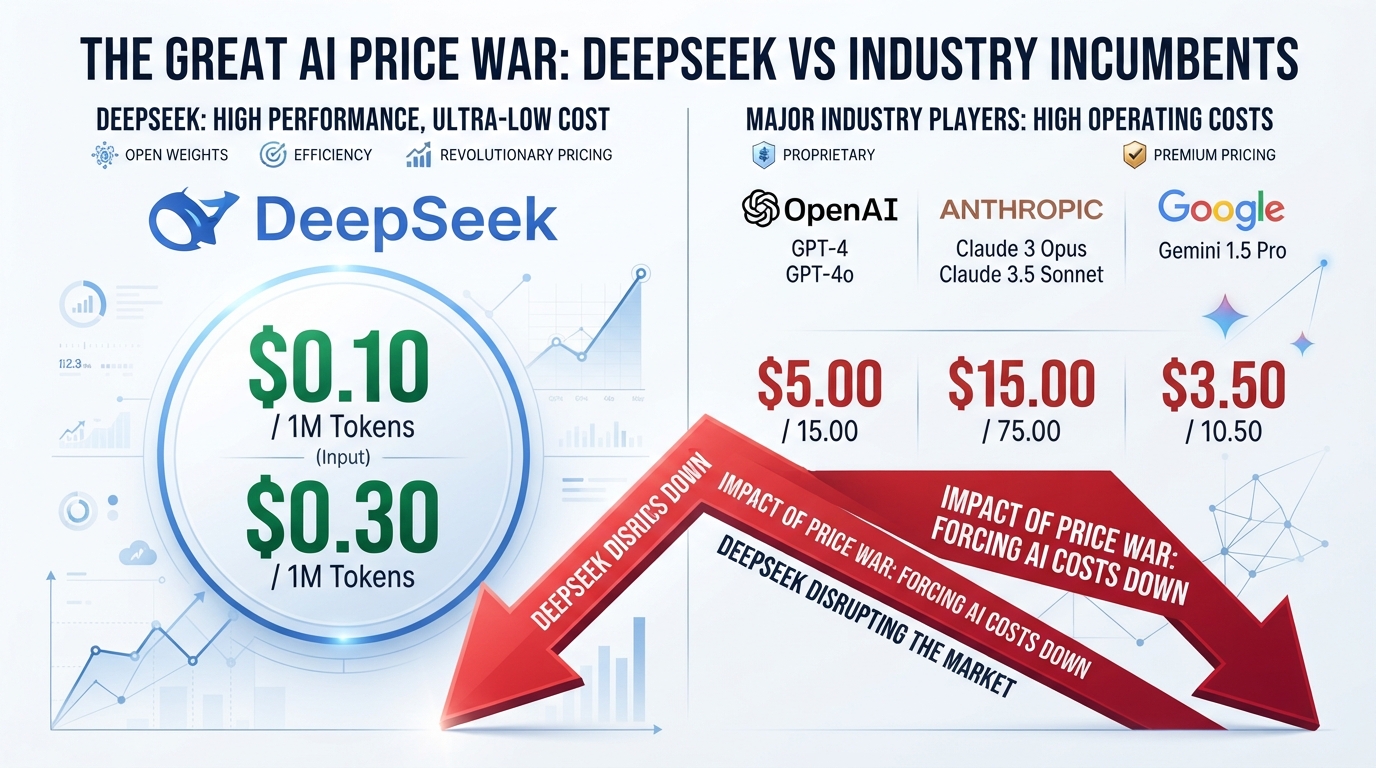
The original discount arrived alongside DeepSeek’s V4 model family launch, and even then, it was generous. API prices for V4-Pro, the company’s flagship reasoning model, dropped from $3.48 per million tokens to somewhere between $0.0035 and $0.83. However, temporary discounts are usually just marketing. Everyone knows the trick: wait it out, and prices bounce back eventually.
A permanent DeepSeek V4-Pro price cut sends a completely different message. In other words, this is the new cost structure, and there’s no going back. As industry writer Tobi Opeyemi Amure put it, promotional discounts come with an expiration date competitors can simply wait past. Permanent ones don’t offer that same luxury.
What the DeepSeek V4-Pro Price Cut Looks Like in Real Numbers
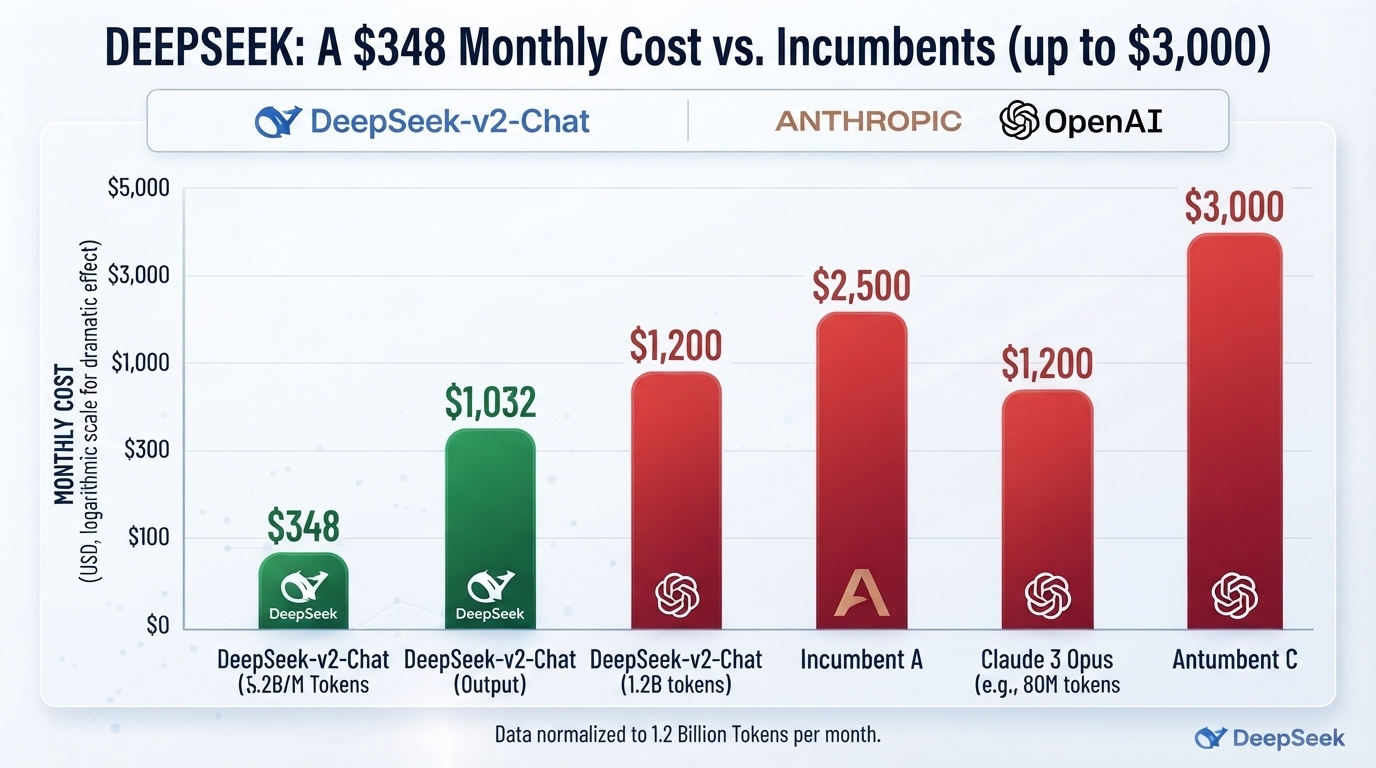
Forget the per-token math for a second. Here’s what this looks like in real monthly costs, based on 100 million output tokens — a fairly typical workload for a mid-size AI app.
| Provider | Model | Monthly Cost (approx.) |
|---|---|---|
| DeepSeek | V4-Pro | ~$348 |
| Gemini 3.1 Pro | ~$1,200 | |
| Anthropic | Claude Opus 4.7 | ~$2,500 |
| OpenAI | GPT-5.5 | ~$3,000 |
That’s not a small gap. It’s the difference between running V4-Pro for seven months versus one month of Claude Opus 4.7. In fact, for the price of one month of GPT-5.5, you could run DeepSeek for almost nine months straight.
Of course, cheap only matters if it’s also good. So the real question developers are asking is simple: does V4-Pro actually hold up?
Why DeepSeek Can Afford to Do This
This isn’t charity. It comes down to hardware economics, specifically Huawei’s Ascend 950 chips.
When V4 launched in April 2026, the Pro version cost 12 times more than the Flash version. That’s mostly because Pro needed far more compute, and DeepSeek’s Ascend 950 supply was still ramping up under US export restrictions. DeepSeek had already predicted that Pro pricing would drop once Ascend supernodes scaled up in the second half of 2026. So why did the DeepSeek V4-Pro price cut happen early, and permanently? A few things could be going on at once: Huawei’s chip supply may be improving faster than expected, DeepSeek’s architecture could simply be more efficient than projected, or the company is using its new funding to buy market share.
Meanwhile, analyst Sanchit Vir Gogia of Greyhound Research pointed to real efficiency gains. According to Gogia, DeepSeek has managed to make the model require less compute and memory, even for complex, large-context tasks. Much of that comes from DeepSeek’s Multi-Head Latent Attention and sparse attention techniques, which the company open-sourced. These aren’t small tweaks, either. They meaningfully cut memory bandwidth needs, which is exactly the kind of change that permanently shifts a company’s cost curve instead of just discounting for a season.
A Funding Round That Tells Its Own Story
None of this happened in isolation. DeepSeek’s valuation jumped from a $10 billion target in April 2026 to somewhere between $45 and $50 billion by May, in about six weeks. The lead investor is China’s “Big Fund III,” a state-backed semiconductor investment vehicle. Notably, this marks its first known direct bet on a large language model company. That’s a strong signal Beijing sees DeepSeek as more than a business success; it’s viewed as a strategic asset in the broader US-China tech race. Tencent, Alibaba, and Hillhouse Capital are also reportedly involved.
Some of that capital is expected to go toward employee equity, which matters in a market where rivals like ByteDance and Moonshot AI are aggressively poaching AI talent. In this race, retention is nearly as important as raw compute.
Can OpenAI or Anthropic Match the DeepSeek V4-Pro Price Cut?
Not easily. Here’s the core problem: American labs pay what’s often called the “NVIDIA tax.” NVIDIA’s data center GPU margins routinely exceed 70%, which means a huge chunk of every inference dollar OpenAI or Anthropic spends flows straight to hardware costs. DeepSeek, on the other hand, sidesteps that entirely by running on Huawei chips. Google sits in a slightly better spot, since it owns its TPU infrastructure. That’s partly why Gemini has generally been priced more competitively than GPT or Claude models. Still, even Google can’t match DeepSeek’s current pricing without eating into its margins.
So, realistically, Western labs have four paths forward. First, match prices, though that’s unlikely since it would gut valuations built on premium pricing. Second, chase efficiency gains through similar architecture innovations. Third, lean harder into differentiation, such as multimodal features and enterprise compliance. Finally, push for policy changes that limit US companies’ use of Chinese AI infrastructure, a conversation already happening in Washington.
How the DeepSeek V4-Pro Price Cut Should Shape What You Build
For most everyday tasks, like coding help, documentation, or general text analysis, DeepSeek V4-Pro now offers a 7-9x cost saving with a performance gap under 5%. However, for complex, multi-step agentic workflows, Claude Opus 4.7 still tends to hold up better over long instruction chains. Similarly, vision and image tasks still favor GPT-5.5 or Gemini, since V4-Pro has no native vision support.
There’s also a quieter cost advantage worth knowing about. DeepSeek charges just 0.8% of input cost for cache hits, compared to roughly 10% for Anthropic and Google. Combined with reportedly higher cache hit rates, this adds up fast over time, even though it doesn’t show up in headline pricing.
Additionally, because V4-Pro is released under an MIT license with open weights, self-hosting is a real option for teams with data residency concerns. That’s a hedge closed-API competitors simply can’t offer.
The DeepSeek V4-Pro price cut isn’t just about being cheap. It’s a structural challenge to how American AI companies have built their business models. In short, the company has shown that a model within striking distance of frontier performance can run at a fraction of the cost. It has also shown that open weights under a permissive license can hold their own against billion-dollar closed APIs.
The next 18 months will reveal whether OpenAI, Anthropic, and Google can close that gap through their own efficiency breakthroughs. Otherwise, the industry may split into two tiers: a high-margin premium layer for teams that need the absolute best, and a “good enough and cheap” layer that becomes the default for everything else. Either way, the DeepSeek V4-Pro price cut has already reset what developers expect to pay for frontier-level AI.