

What Authority Labs AI is and what problem it solves in 2026
In 2026 AuthorityLabs remains a SEO rank tracking and keyword visibility platform focused on giving marketers, agencies, and SEO professionals reliable insights into where content ranks in search engine result pages (SERPs) over time. It does not currently offer an AI-branded generative assistant or extensive machine-learning-driven recommendations that you see in broad SEO suites like Semrush or Ahrefs; rather, its value comes from accurate daily ranking data, localized and mobile tracking, competitor keyword monitoring, and reliable reporting workflows that help teams understand how their keywords perform, when visibility shifts occur, and where strategic adjustments are needed. The platform’s predictive aspects historically have been based more on data trends and automated scheduling than on explicit AI generation, but it’s increasingly compared in the market with newer AI-enabled rank tracking tools as expectations evolve.
Who owns Authority Labs and the company behind it
AuthorityLabs’ SEO rank-tracking platform is maintained by AuthorityLabs — part of the broader Traject Data group of digital marketing tools. The company positions itself as a dependable, data-centric provider of search ranking and keyword visibility services for teams that need consistent, automated SEO data without complex all-in-one environments. Its cloud-based SaaS solution allows marketers to track rankings without installing software or long-term contracts.
How Authority Labs actually works
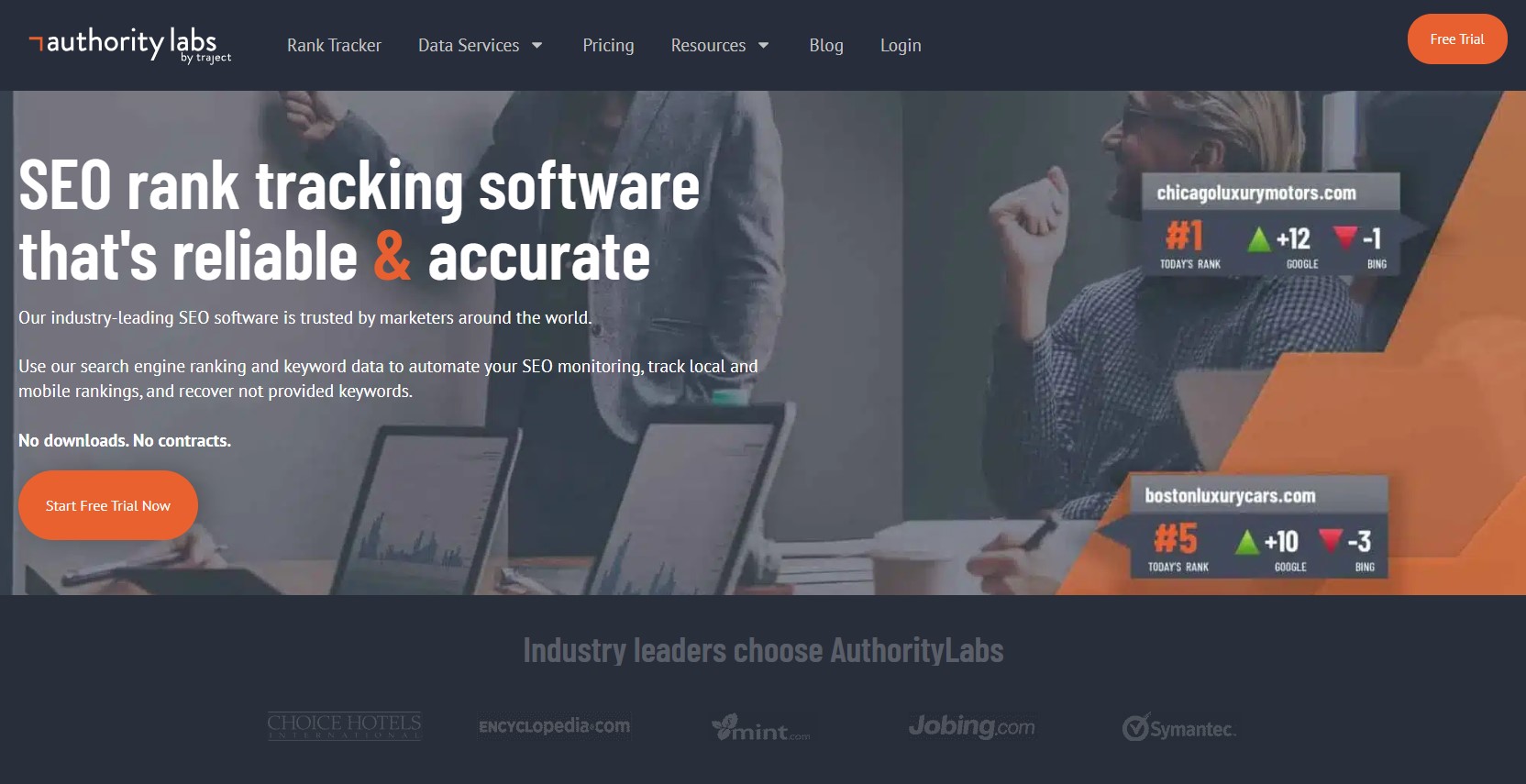
AuthorityLabs operates as a cloud-based rank tracker that automatically collects keyword ranking positions from major search engines like Google, Bing, and Yahoo for any domain, keyword set, or locale you configure. Users input the keywords and sites they want to monitor, and AuthorityLabs performs daily searches on their behalf to return where those keywords rank in both desktop and mobile views — including local zip code or city-specific tracking when needed. It surfaces historic trends, competitor rankings side-by-side, SERP feature appearances, and pulls “not provided” keyword insights by correlating data sources. Although the platform doesn’t offer a generative AI assistant per se, data automation, alerting, and reporting mechanics are designed to reduce manual spreadsheet work and deliver actionable visibility signals daily.
Real-world use cases and how professionals use it today
Marketers and SEO professionals use AuthorityLabs to track organic search performance over time — for product pages, service pages, brand terms, and broader topical clusters — with daily updates that highlight rising or falling visibility. Agencies use its white-label reporting capabilities to share branded insights with clients without additional login friction. Teams monitor mobile and local rank changes to adjust local SEO strategies and pin down performance in specific service areas. Competitor tracking lets practitioners benchmark where competitors rank for overlapping keyword sets, aiding strategy refinement. API access (at higher plans) enables integration of rank data into internal dashboards or BI systems, generating centralized visibility reporting for larger teams.
Current pricing plans in 2026
AuthorityLabs continues with tiered subscription pricing based on the number of keywords and domains you need to track. Current 2026 published plans include a Plus plan around $65 per month for smaller keyword sets and core rank tracking, a Pro plan around $129 per month with expanded limits and early integrations like Google Data Studio, a Pro Plus plan near $295 per month for larger projects, and an Enterprise tier near $585 per month offering high-volume keyword and domain capacity along with API access and white-label capabilities. All plans include a 14-day free trial with no credit card required.
How pricing compares to competitors
Compared with broader SEO products that bundle AI-assisted insights, keyword research, content optimization, and technical audits, AuthorityLabs’ pricing sits below most full SEO suites but aligns with dedicated rank trackers and SERP monitoring tools. For pure rank tracking, its tiers are competitive versus tools like Nightwatch or ProRankTracker, though platforms with AI-oriented alerts and overview visibility tracking may charge similar or slightly higher costs while offering additional automation or intelligence layers beyond basic rank positions. AuthorityLabs tends to be simpler in scope, which can make it more cost-effective when deep generative AI features are not a priority.
Who should use Authority Labs and who should not
AuthorityLabs is best suited to SEO specialists, agencies, and in-house digital teams that need accurate daily rankings, local and mobile position data, and straightforward trend reporting without the complexity of full SEO suites. It’s particularly appealing for client reporting workflows and teams that don’t require extensive content or technical analysis tools. However, it is less appropriate for organizations seeking deep AI-augmented insights, generative content optimization, AI overview visibility metrics, or integrated keyword research along with rank tracking — use cases better served by SEO platforms that combine ranking data with broader analytics and automation.
Strengths, limitations, and realistic drawbacks
Among AuthorityLabs’ strengths are its reliable daily data, clean rank tracking interface, local and mobile keyword tracking, competitor comparison, and unlimited user access on higher tiers. Its APIs and reporting features make it appealing for integration and client dashboard workflows. Limitations include a lack of built-in AI assistant capabilities — such as automated content recommendations or generative visibility analysis — and feature scope limited mostly to ranking data rather than full SEO analytics or content intelligence. Some users also note that while the tool excels at what it does, it doesn’t replace larger suites when a holistic SEO strategy requires link analysis, on-page suggestions, or AI-driven content insights.
How Authority Labs is being used in businesses and teams
In real workflows, SEO teams embed AuthorityLabs into weekly and monthly performance reviews, combining rank trend charts with strategic planning. Agencies generate automated white-label reports sent directly to clients via email or dashboards, helping justify SEO deliverables. Local SEO specialists track city- or zip-level rank changes to optimize localized content and measure SERP shifts after on-page changes. Enterprise teams feed rank data into broader analytics stacks through APIs, aligning ranking performance with conversion and traffic metrics for executive reporting.
Why Authority Labs matters in the AI landscape in 2026
Even as AI search reshapes discovery, rank tracking remains a foundational SEO metric — especially when understanding how visibility evolves in traditional SERPs. While AuthorityLabs may not itself offer advanced AI citation metrics, knowing where you rank daily and how local/mobile positions shift continues to inform content strategy and competitive moves, particularly where correlated with AI visibility signals tracked by other tools or analytics. Its simplicity and reliability help teams focus on trend changes that matter before investing in deeper AI-augmented insights elsewhere.
A concise final verdict written like a human expert
In 2026 AuthorityLabs is a solid, dependable rank tracking platform that excels at what it has always offered: clear, accurate daily keyword performance data with local and mobile specificity. It isn’t a full SEO suite nor does it host a generative AI assistant for optimization recommendations, but for teams whose primary need is understanding ranking trends and reporting them reliably, it remains a practical tool. Its pricing is competitive with other rank trackers, and its reporting features and API access make it useful for agencies and internal teams alike. However, marketers seeking deeper AI-driven insight — such as AI overview visibility or automated content suggestions — will need to complement AuthorityLabs with larger, more AI-integrated platforms.