
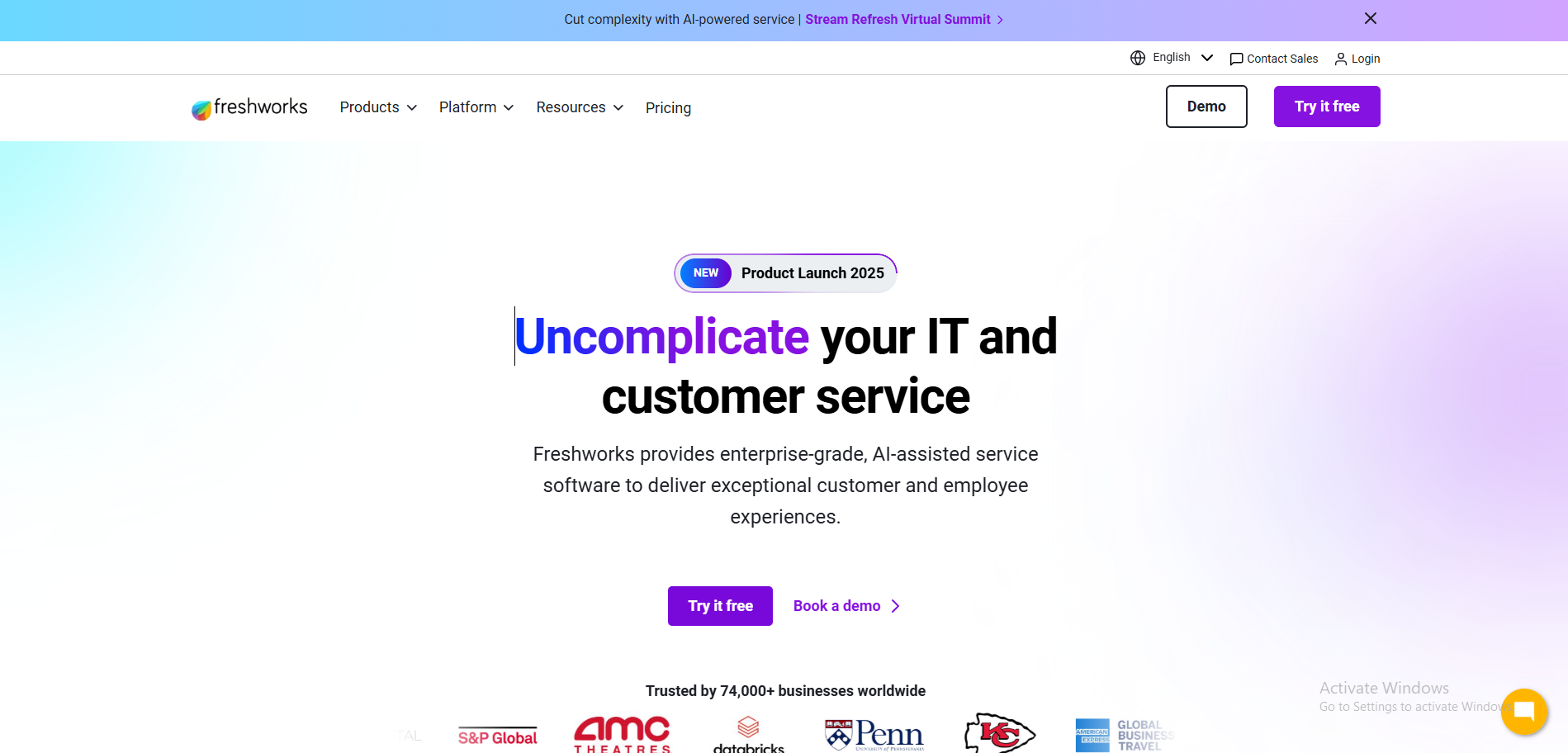
In 2026 Freshworks AI — broadly understood as the suite of AI‑enhanced capabilities embedded across Freshworks products and powered by the proprietary Freddy AI engine — stands as one of the most mature and widely adopted enterprise AI tools focused on customer experience (CX), employee experience (EX), and CRM workflows. Freshworks itself does not sell a standalone “Freshworks AI” product with a single name; rather, AI is integrated as a core part of its cloud SaaS offerings such as Freshdesk for customer service, Freshsales for CRM, Freshservice for IT service management, and related modules. The modern AI layer is commonly referred to as Freddy AI and represents Freshworks’ strategic investment in generative and autonomous AI technologies.
What Freshworks AI is and what problem it solves in 2026 centers on a fundamental gap in enterprise software: most CRM and service platforms treat artificial intelligence as an optional suggestion engine. Freshworks instead uses Freddy AI to automate and resolve routine tasks, reduce manual work, and provide actionable insights across customer and employee interactions. This includes automating ticket resolution up to end‑to‑end response flows, summarizing conversations for agents, generating recommended actions, and surfacing trends and anomalies across service and sales data. AI is deployed across channels — email, chat, WhatsApp, and social messaging — both to improve response speed and to scale human teams without proportionally increasing headcount.
Freshworks AI is owned by Freshworks Inc., a publicly traded SaaS technology company listed on the Nasdaq under the ticker FRSH. Founded in 2010 and headquartered in San Mateo, California, the company was originally bootstrapped as Freshdesk and has since grown into a multi‑product platform addressing CRM, customer and employee service, marketing, ITSM, and HR workflows. As of early 2026, Freshworks serves tens of thousands of global customers and continues to expand both organically and via strategic acquisitions, including a 2025 acquisition to deepen its AI‑native IT service offerings. Freshworks is led by CEO Dennis Woodside, who succeeded founder Girish Mathrubootham and continues to steer the company through an AI‑centric growth phase.
The way Freshworks AI actually works is rooted in Freddy AI — a generative and autonomous AI engine embedded natively into the software stack. Practical capabilities include Freddy AI Copilot, which runs alongside human agents and suggests replies, summarizations, and next‑best actions; Freddy AI Agents, which are autonomous digital agents that can launch workflows, interact with backend systems, and resolve up to 80% of routine customer queries without human intervention; and Freddy AI Insights, which uses conversational and contextual analytics to proactively surface trends, anomalies, and root causes in support and service operations. These components can be deployed with minimal setup, no dedicated data science team, and are designed to “think” and act across integrated systems like Shopify, Stripe, and FedEx via pre‑built or custom agentic workflows.
In real‑world use cases today, Freshworks AI is used by customer support teams to automate ticket triage and resolution, by sales teams to score leads and personalize outreach, and by IT service teams to anticipate and prevent operational bottlenecks. Support organizations report that automation and agent assist features free up human talent from repetitive tasks, improving both productivity and job satisfaction. In CRM workflows, AI helps prioritize opportunities, draft personalized communication, and reduce duplicate records. EX teams use AI to streamline employee onboarding and internal helpdesk responses, a trend accelerated by hybrid and remote work expectations. Adoption spans small and medium businesses up to enterprises that value simplicity without sacrificing modular scalability.
Pricing plans in 2026 reflect Freshworks’ modular, tiered approach. Core product tiers across Freshdesk, Freshsales, and Freshservice typically include Free, Growth, Pro, and Enterprise levels, with prices roughly starting at $9–$15 per user or agent per month for entry tiers, around $39–$49 per user on mid‑level plans, and custom pricing on Enterprise plans. AI functionality is often included at higher tiers or as add‑ons. For example, Pro and Enterprise plans may include a limited number of free AI agent sessions, while Freddy Copilot is available as a paid add‑on starting at approximately $29 per agent per month, and additional AI agent usage is billed on a session basis (e.g., per 1,000 sessions). Free trials are commonly offered for evaluation.
Compared to competitors like Salesforce, HubSpot, or ServiceNow, Freshworks’ pricing tends to be more transparent and accessible, especially for SMBs. Major competitors often charge premiums for comparable AI automation, while Freshworks bundles core AI capabilities into platform tiers or add‑ons that scale with usage. However, larger enterprises with deeply customized workflows may find the feature set and governance capabilities of higher‑end competitors more comprehensive; Freshworks tends to trade deep customization for rapid deployment and ease of use.
Who should use Freshworks AI? It is well suited for customer support organizations, sales teams, and IT service groups looking to scale operations without proportional headcount increases, and for companies seeking a unified suite that blends CRM, support, and automation. Smaller teams and startups benefit from its ease of onboarding, while enterprises that desire deep, low‑level customization and advanced governance controls might find other platforms more aligned to their needs. Businesses that need rigid regulatory controls or bespoke process engines might also outgrow the Fresworks ecosystem.
Strengths of Freshworks AI include rapid setup, intuitive interfaces, omnichannel support, and a lower total cost of ownership relative to many legacy platforms. The integrated AI capabilities genuinely automate tasks beyond simple suggestions, which has led to measurable productivity improvements. Limitations include feature gating behind higher pricing tiers, integration complexity with niche third‑party systems, and fewer deep customization options than some enterprise competitors. There are also practical considerations around AI governance and session‑based pricing that can make costs variable as usage scales.
Within businesses and teams, Freshworks AI is increasingly embedded into daily workflows. Support agents use it to handle high volumes of inquiries with more context and less manual effort. Sales teams incorporate AI scoring and messaging into pipeline management. Service leaders leverage AI insights to reduce escalations and preempt service issues. Some organizations are using the AI Agent Studio to create vertical, industry‑specific agent workflows that handle business logic from external systems directly, reducing operational friction.
In the broader 2026 AI landscape, Freshworks AI matters because it illustrates a practical, accessible path for organizations to integrate generative and autonomous AI into essential business operations without the overhead of custom AI development. Instead of positioning AI as an isolated tool, Freshworks embeds it into workflows that millions of users already rely on, thereby democratizing advanced automation. This matters in an era where efficiency and personalized experiences are competitive differentiators but technical barriers still slow adoption.
The verdict on Freshworks AI in 2026 is that it is a solid, enterprise‑ready AI suite that balances power with usability. It does not promise AI magic but delivers tangible automation and insight capabilities that align with real business needs. Its modular pricing and broad use cases make it a compelling choice for growth‑oriented teams, while its limitations in deep customization and governance should be weighed by larger enterprises with specific requirements. Overall, Freshworks AI represents a mature and credible evolution of CRM and service automation tools, built for AI‑assisted productivity rather than theoretical innovation.