
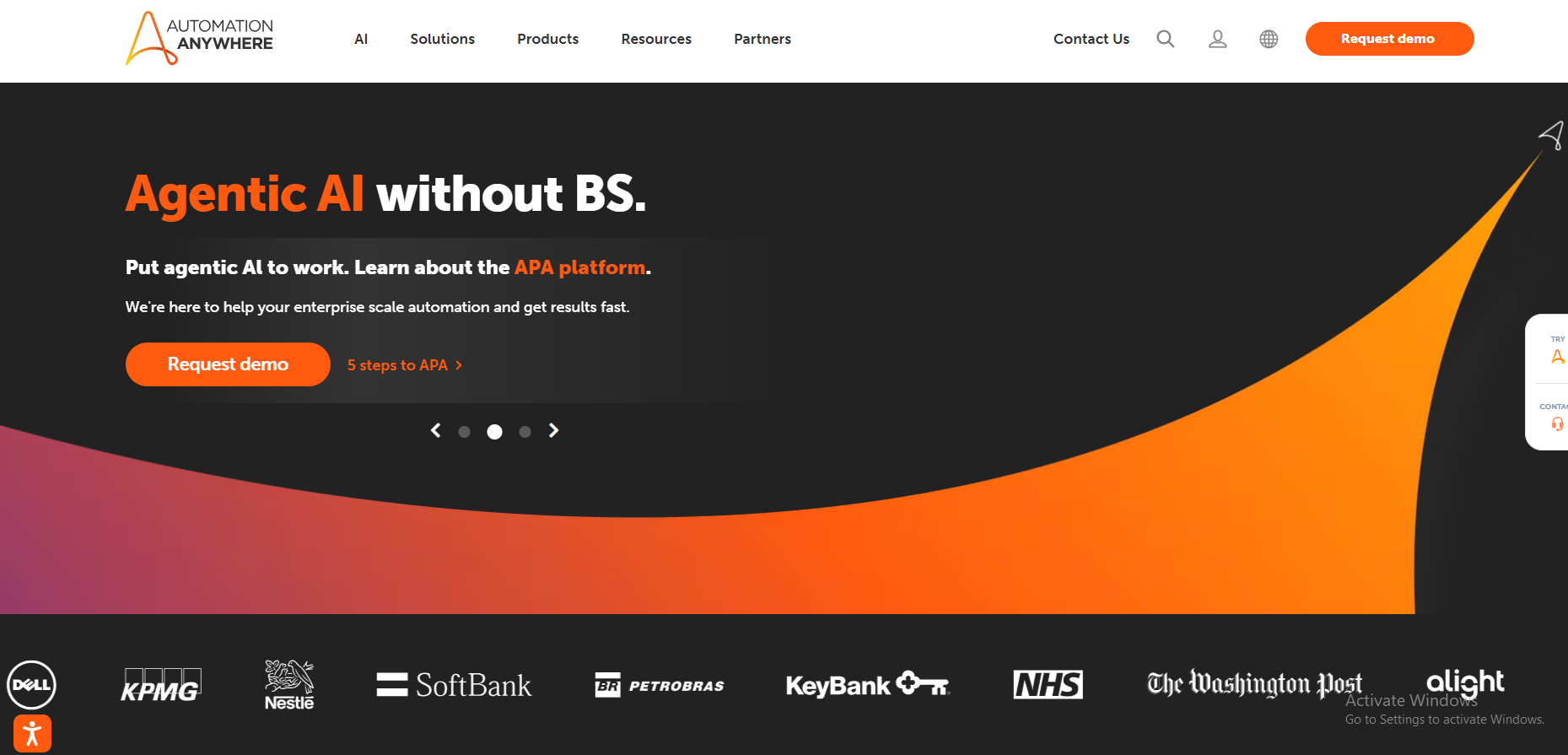

Automation Anywhere AI in 2026 is best understood not as a single standalone product but as the AI-enabled core of the broader Automation Anywhere Intelligent Automation and Agentic Process Automation platform, increasingly positioned as the enterprise solution for digital work orchestration and AI-augmented automation across complex business operations. In today’s enterprise landscape, Automation Anywhere AI blends robotic process automation (RPA) with generative AI, multi-modal reasoning, and adaptive, goal-oriented agents to reduce manual effort, eliminate silos, and help organizations scale automation with governance and security at the center.
Automation Anywhere AI solves the problem of turning repetitive, rules-based and semi-structured tasks into dependable, scalable automation outcomes while enabling AI-driven reasoning, decision support, and orchestration across legacy and modern systems. Rather than limiting automation to preconfigured scripts, the platform uses AI to understand context, adapt to changes, and coordinate workflows that require judgment, data interpretation, cross-system interactions, and human-in-the-loop validation. This approach addresses key enterprise pain points such as inconsistent manual processes, bottlenecks in document-centric workflows, and the inability to unify automation with AI decisioning at scale.
Automation Anywhere itself is a privately held enterprise software company headquartered in San Jose, California, founded in 2003 by Mihir Shukla, Neeti Mehta Shukla, Ankur Kothari, and Rushabh Parmani. Its leadership continues to focus on building what the company terms an “Agentic Process Automation System” that embeds AI deeply into operational automation. In early 2026 there are credible reports that Automation Anywhere and C3.AI are in merger discussions that, if successful, could see Automation Anywhere acquire C3.AI and pursue a public listing via the transaction, although these talks remain preliminary and unconfirmed by the companies.
Under the hood, Automation Anywhere AI operates through a Process Reasoning Engine (PRE) and a suite of AI-friendly components that connect LLMs, enterprise knowledge, APIs, applications, and human inputs into adaptable workflows. PRE is trained on hundreds of millions of enterprise automation flows, enabling context-aware decision-making rather than simple pattern matching. The platform integrates generative AI, traditional RPA, human-in-the-loop components, and orchestration layers to produce what Automation Anywhere calls agentic automation—AI agents capable of pursuing business outcomes rather than merely executing scripted tasks. These agents can plan, interpret multi-modal inputs (documents, APIs, databases), recover from errors, and adapt over time. The platform also supports custom LLMs from OpenAI, Azure, Google, Amazon, and others, underscoring its extensibility for enterprise AI strategies.
In real-world use, organizations use Automation Anywhere AI to automate invoice processing, claims management, customer service routing, supply chain orchestration, regulatory compliance workflows, and cross-system transaction processing at scale. Financial institutions automate transaction reconciliation and anti-money-laundering alerts; healthcare providers leverage intelligent document automation for billing and prior authorizations; and supply chains coordinate procurement, inventory, and fulfillment systems with minimal manual intervention. These implementations typically deliver measurable time savings, accuracy improvements, and capacity to scale automation beyond traditional RPA boundaries.
Pricing for Automation Anywhere in 2026 remains opaque on the official site, reflecting the enterprise-custom, negotiations-based model that most large automation vendors use. Publicly available user-reported data suggests smaller cloud starter bundles in the ballpark of $750 per month for a basic combination of control room and bot licenses, with additional license types and bots adding material costs. Typical enterprise agreements are custom quoted and can range into mid-six figures or more annually depending on scale, governance, and advanced AI capabilities. Automation Anywhere also offers a Community Edition for students and developers to explore the platform for free.
Compared to competitors, Automation Anywhere’s pricing tends to position at the higher end of the RPA and intelligent automation market, especially when advanced agentic AI capabilities are included. Users comparing it to UiPath or Microsoft Power Automate frequently cite Automation Anywhere as more expensive but delivering strong governance, enterprise alignment, and integration depth—though sentiment varies by region and organization size. Smaller teams or budget-constrained buyers often find alternatives more accessible price-wise, while large enterprises benefit from the platform’s comprehensive governance and scalability.
The ideal users of Automation Anywhere AI are mid-to-large enterprises with complex workflows, strict governance requirements, and the need to integrate automation deeply into business processes. These organizations typically have heterogeneous system landscapes, regulatory demands, and the scale to justify robust automation investments. Users who should not choose it are very small teams, simple task automation needs that could be addressed with lower-cost tools, or highly technical environments where bespoke script-based automation is preferable. The overhead of implementation, licensing complexity, and enterprise orientation make it less attractive for casual or individual automation needs.
Strengths of Automation Anywhere AI include deep enterprise focus, strong governance controls, contextual decision-making, multi-modal integration, and agentic capabilities that extend beyond routine RPA. Limitations include pricing opacity, implementation complexity, and higher total cost of ownership for smaller deployments. Realistic drawbacks often cited by practitioners include a steep learning curve, occasional mismatches between vendor claims and on-the-ground performance, and the need for skilled personnel to configure, govern, and maintain complex agentic automations.
In business teams, Automation Anywhere AI is increasingly embedded in enterprise digital transformation initiatives. Teams use it to augment knowledge workers rather than replace them—employees oversee AI agents, validate exceptions, and refine process models. This creates a hybrid human-AI operational model that prioritizes reliability and compliance. Organizations often establish Centers of Excellence (CoE) to govern bot portfolios, measure ROI, and standardize automation practices across departments.
Automation Anywhere matters in the 2026 AI landscape because it represents a transitional platform where automation and AI converge for enterprise outcomes. Unlike point tools focused solely on generative AI or narrow RPA, Automation Anywhere aims to provide an integrated fabric that brings AI reasoning, orchestration, and governance into day-to-day business operations. Its evolution toward agentic systems anticipates future demands for adaptive, outcome-driven automation that can scale across industries. The potential merger with C3.AI, if realized, could further amplify its position by combining deep AI analytics with operational automation at scale.
In expert analysis, Automation Anywhere AI is a leading enterprise automation platform with strong AI capabilities, suited for organizations with complex, regulated, and high-volume automation needs. Its blend of RPA, reasoning engines, agentic orchestration, and enterprise governance positions it as a long-term strategic solution, though its complexity and cost mean it is not ideal for smaller or simpler automation tasks. As the AI automation market continues to evolve in 2026, Automation Anywhere’s focus on agentic process automation keeps it relevant for digital transformation initiatives that require both intelligence and operational control.