
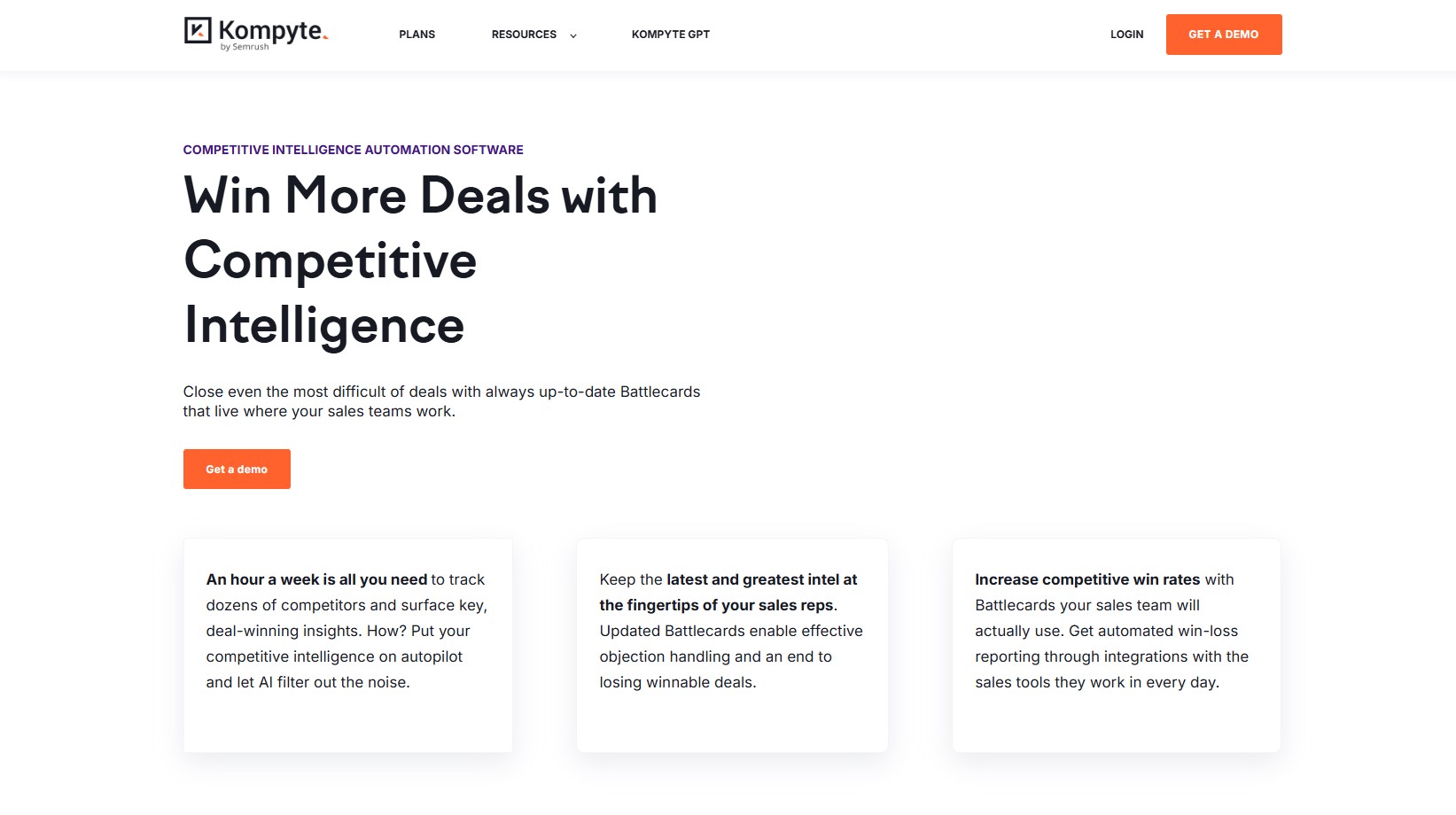
Kompyte AI, often referred to simply as Kompyte, is a competitive intelligence and automation platform widely used in 2026 to help businesses monitor and respond to competitor activity in real time. At its core, Kompyte solves the persistent problem of manual competitive research by continuously tracking changes across competitors’ digital footprints—such as websites, social media, product pages, advertising, pricing, job postings, and reviews—and using artificial intelligence to filter, prioritize, and deliver actionable insights to business teams. This automation significantly reduces the time and effort teams spend on manual scans and static reports, enabling more timely decision‑making across sales, marketing, product, and strategy workflows.
Kompyte is owned by Semrush Holdings, Inc., a publicly traded SaaS company headquartered in Boston, Massachusetts, that specializes in online visibility management and digital marketing technology. Semrush acquired Kompyte in 2022 as part of its broader strategy to expand beyond traditional search engine marketing tools into competitive intelligence and sales enablement. Since that acquisition, Kompyte has operated as a product line within the Semrush ecosystem, benefiting from integrated data sources and enterprise reach. Semrush itself is a major player in the AI‑assisted analytics space, serving large global customer bases with tools for SEO, PPC, market research, and competitive insights.
In practical terms, Kompyte works by continuously crawling and monitoring millions of data points across hundreds of public sources, comparing current information with historical records to detect meaningful changes. The platform’s AI layer classifies updates and filters out noise—such as trivial website edits—so users see only relevant developments like pricing changes, new feature announcements, shifts in messaging, or competitor hiring moves. Users can customize tracking preferences, set alerts, and generate summaries that highlight trends or specific competitive events. Kompyte integrates those insights into dashboards and tools where teams already work via bi‑directional connections with CRMs (like Salesforce and HubSpot) and communication platforms (like Slack and Microsoft Teams), ensuring intelligence reaches sales reps and decision‑makers without extra effort.
Real‑world use cases for Kompyte reflect its cross‑functional value. Sales teams use Kompyte to generate and update battlecards—concise, actionable summaries of competitor strengths, weaknesses, pricing, and positioning—so reps can handle objections and close deals more effectively. Marketing teams leverage automated competitor tracking to refine campaign messaging and respond quickly to shifts in competitor activity, while product teams use alerts and trend analyses to inform roadmap decisions based on competitor feature releases or strategic moves. Executive leadership teams rely on aggregated competitive dashboards for a high‑level view of market dynamics that influence investment and strategic planning.
As of 2026, Kompyte’s pricing structure is tiered into Essentials, Professional, and Unlimited plans. The Essentials tier includes tracking for up to 10 competitors and 25 user licenses, with unlimited battlecards and reports. The Professional tier increases competitor and user limits and provides access to a broader competitor database, while the Unlimited tier removes tracking limits entirely and adds enterprise features such as single sign‑on (SSO) and advanced user permission controls. All plans include personalized onboarding, ongoing support, and integrations without additional fees. Pricing is typically quoted based on the number of competitors tracked and user licenses needed, and customers must engage with Kompyte sales to get specific figures.
Compared to competitors in 2026, Kompyte sits in a mid‑range position. Platforms like Crayon often capture broader data reach with larger source footprints and deep market monitoring, while Klue emphasizes enterprise‑level integration and robust team workflows. Kompyte’s integration within the Semrush ecosystem provides a unique advantage by combining competitive intelligence with SEO and marketing data, but it generally sees lower traffic and market share than some competitors. Users on review sites also note that Kompyte’s dashboard and ease of use may be slightly less polished than alternatives, although its data flexibility and integrations remain strong.
Kompyte is best suited for mid‑market and enterprise teams that need automated competitive monitoring without building internal research functions. It aligns well with organizations that already use CRM and collaboration platforms and want to tie competitive insights directly to revenue and product decisions. Smaller businesses with limited budgets or teams seeking lightweight competitor scans may find Kompyte’s cost and onboarding overhead less ideal, especially if they do not require deep sales enablement features. Organizations focused on offline or private competitive intelligence—which requires non‑public data—also may find Kompyte’s public web focus a limitation.
Among Kompyte’s strengths are its real‑time tracking across diverse digital channels, AI‑filtered insights that reduce manual noise, and tight integrations that bring competitive intelligence into existing workflows. Its battlecard automation and win‑loss reporting capabilities help sales and marketing teams become more responsive to market shifts. Limitations include some user interface complexity for new users, occasional misclassification of alerts that require manual review, and a dependency on publicly available digital activity—meaning it may miss private strategic moves or nuanced competitor context.
In business teams today, Kompyte is used to streamline competitive research that would otherwise consume hours of manual work each week. Sales enablement programs leverage automated battlecards to improve win rates, while product and marketing teams conduct rapid comparative analyses to inform strategy and messaging changes. Across organizations, Kompyte functions as a centralized source of competitive truth, helping reduce the friction of dispersed data and enabling cross‑department alignment around market signals.
Kompyte matters in the 2026 AI landscape because it represents a shift from reactive, manual competitive research toward continuous, AI‑assisted market awareness that feeds directly into business operations. In an era where speed and context can determine revenue outcomes, automated intelligence platforms like Kompyte help businesses make informed decisions faster, linking competitor activity with strategic actions across sales, marketing, and product.
In final analysis, Kompyte stands as a robust competitive intelligence tool that delivers real‑time insights and practical applications for modern business teams. Its integration with Semrush’s broader data ecosystem enhances its value for companies already invested in SEO and digital analytics, and its automation significantly reduces the manual workload associated with competitor tracking. While not the perfect fit for every team—particularly those seeking ultra‑lightweight tools or deep private intelligence—the platform’s balance of features, integrations, and actionable outputs makes it a worthwhile investment for organizations serious about staying ahead in competitive markets.